
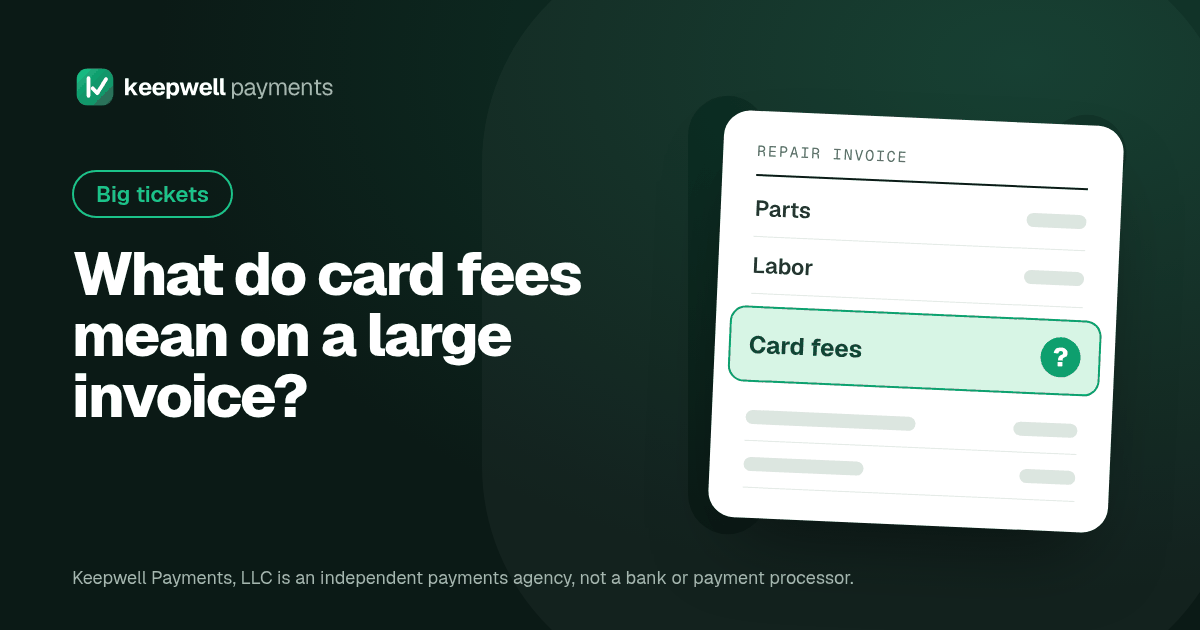
Repair shops write big tickets: a brake job, a transmission, body work after an accident. When those tickets are paid by card, the fees on each one are easy to notice. Here's how to see what card fees mean on a large invoice, using one example.
How much of a big repair ticket goes to card fees?
It depends on your effective rate: your total card fees divided by your total card sales. When fees are charged as a percentage, the same rate takes more dollars from a bigger invoice. Here's one example.
Example: a $1,500 repair job at a 3.0% effective rate. The card fees on that one job come to $45 ($1,500 × 3.0% = $45). Illustration only, not a quote. Results vary.
Same percentage, bigger ticket, more dollars. That's why big repair jobs make card fees easy to feel. Your own rate may be higher or lower than the example.
How do you find your own rate?
To find your own rate, take the total fees on your statement and divide by your total card sales. Multiply by 100 to see it as a percentage:
Total fees ÷ total card sales × 100 = your effective rate (%)
Use a full month's statement. Our guide to reading your processing statement shows where to find both totals.
Where do big tickets show up on your statement?
Fees on large sales sit with the fees on every other sale, in the per-transaction and percentage-based charges and in the monthly totals. Also check how each payment was taken. A card number typed in by hand often costs more than a card that's tapped or dipped, so check whether invoices paid by phone are being keyed in.
Then look for monthly fees. They're charged whether you run one big job or fifty small ones, so it helps to know which lines they are.
What should you ask your provider?
Ask your provider three things:
- How are large and keyed-in payments priced?
- Which fees on my statement are monthly?
- Can you explain every line in writing?
If you're reviewing a new agreement, see Before You Sign: 9 Questions to Ask Any Merchant Services Provider for more.
Frequently asked questions
How much are card fees on a large repair job?
It depends on your effective rate. For example, at a 3.0% effective rate, the card fees on a $1,500 repair job come to $45. That's an illustration, not a quote. Results vary.
How do I find my shop's effective rate?
Take the total fees on your statement and divide by your total card sales, then multiply by 100 to see it as a percentage. Use a full month's statement.
Why do card fees feel bigger on big repair jobs?
Same percentage, bigger ticket, more dollars. When fees are charged as a percentage, the same rate takes more dollars from a bigger invoice, so the fees on one large job are easy to notice.
Do keyed-in card payments cost more?
A card number typed in by hand often costs more than a card that's tapped or dipped. Ask your provider how large and keyed-in payments are priced on your account.
How we approach it at Keepwell
Want a second look? Send us one month's statement for a free review. We'll walk you through what each line means for a shop that writes big tickets. A review can show whether another setup may cost you less. Results vary.
Want us to look at your statement? Upload it at keepwellpayments.com/upload for a free, no-obligation review.
Keepwell Payments, LLC is an independent payments agency. Accounts are set up with a payment processor we partner with, named before you sign. Merchant accounts are subject to approval. Results vary by business. Examples are illustrations, not quotes. This article is general information, not financial advice.